In this article
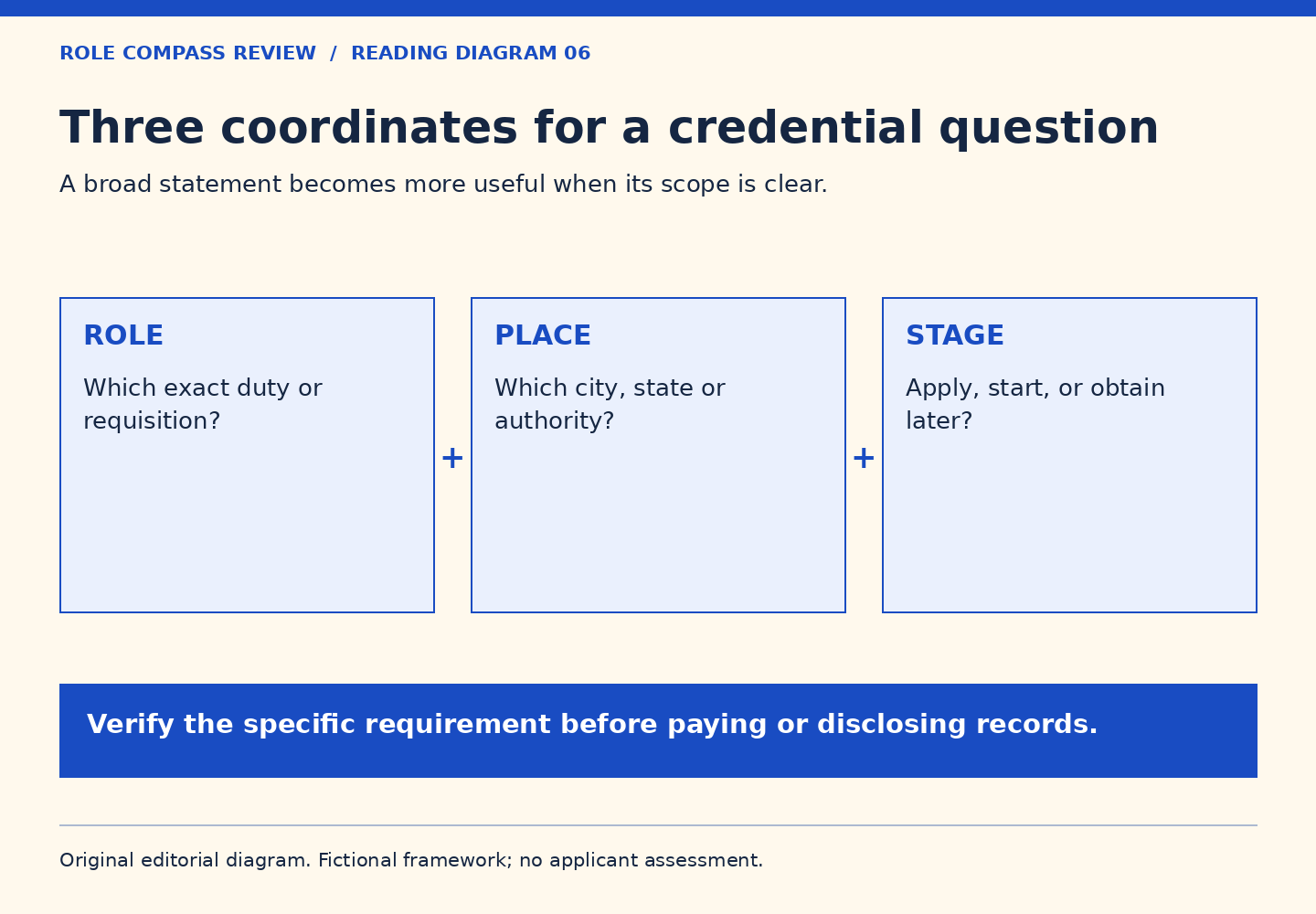
Avoid universal licensing assumptions. Tie every credential question to the specific role, location and point in the hiring process.
Start with the sentence you actually have
A credential can appear in a description as a requirement, a preference or something to obtain later. Preserve the exact distinction in your private notes, then identify the location and requisition to which it belongs. A credential mentioned in one opening is not automatically a requirement for another role with a similar title.
The employer’s public FAQ says licensing arrangements vary by location. That is a reason to seek a specific answer, not permission to infer a rule for your state or city. This article does not describe local law, assess legal eligibility or recommend a particular course provider. The current employer and relevant licensing authority are the appropriate sources for specific requirements.
Separate possession from timing
Three questions are often compressed into one: Is the credential relevant? Must it already be held? At what stage is it required? A page that answers the first may leave the second or third unresolved. Keeping all three visible prevents “may obtain” from becoming “must already have” or “not needed at all.”
A fictional posting might say an applicant must be able to obtain a credential after hiring. That is not equivalent to a promise that the employer will obtain it, pay for it or approve every applicant. Those are separate claims that need their own evidence. Do not add them merely because they would make the process easier to imagine.
Verify before paying or disclosing
If a credential question could lead you to spend money, first establish the exact requirement and the source responsible for it. An advertisement for a course is not an employer confirmation. A generic career article is not a licensing authority. Keep the distinction between learning about a subject and purchasing something supposedly necessary for an opening.
You do not need to send credential numbers, identity documents or background records to this publication to discuss its writing. Keep sensitive material within the appropriate verified employer or authority process. A public correction can identify the article and the public source without including an applicant’s personal records.
Make the unresolved question narrow
Instead of asking whether every security job needs the same credential, ask which requirement applies to the named requisition in the named location and when it must be satisfied. This gives the responsible source something concrete to clarify. Record the answer with its date and scope rather than treating it as a permanent rule for the whole company.
If a posting and a general page seem inconsistent, do not resolve the discrepancy by selecting the more convenient sentence. They may discuss different duties, locations or stages. Keep both references and seek clarification. The ability to identify the exact uncertainty is a useful outcome in itself; it protects you from making a costly decision on a broad phrase that was never meant to answer your particular question.
Source note and limits
Public sources checked October 9, 2026. The discussion above is original editorial analysis. A public posting can change or close; this publication does not verify an opening, evaluate an applicant or make an employment offer.
- External official source: Allied Universal careers FAQs. Supports narrow statements that pay varies by location/assignment/experience, licensing varies, and applicant accommodations have an employer contact route. General FAQ language does not resolve a particular posting.