In this article
Keep the force of a qualification intact. A careful reading separates explicit requirements, preferences and conditions without inventing eligibility rules.
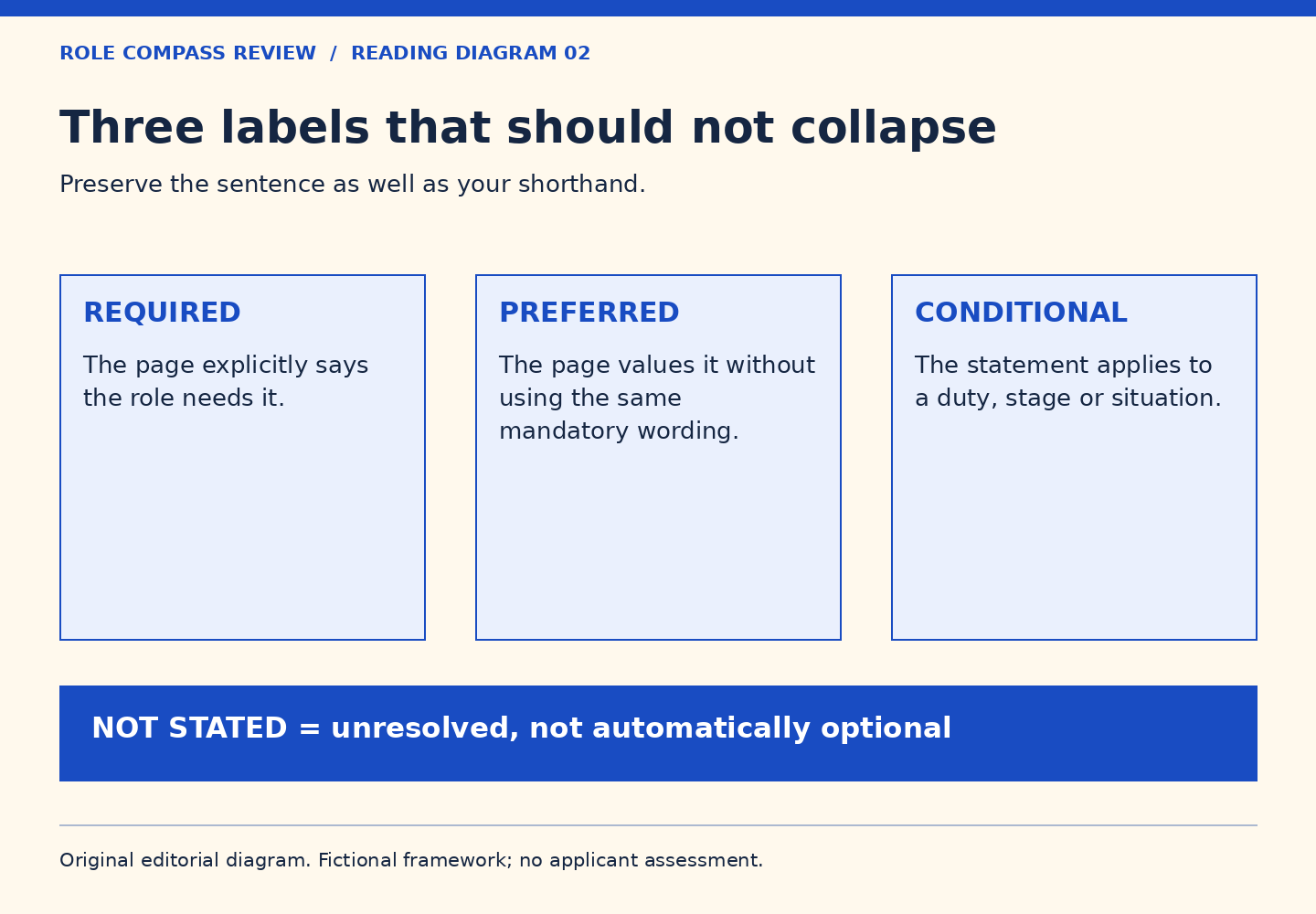
Three labels, three jobs
An explicit requirement states something the employer says the role needs. A preference describes something it values without using the same mandatory language. A condition ties a statement to a situation, stage or duty. Treat these as reading labels rather than legal categories. The exact sentence and the current employer explanation remain more important than your shorthand.
When a sentence contains several parts, separate them before labeling it. “Experience with a system preferred; ability to travel required” contains two different signals. Highlighting the whole line as either required or optional destroys useful information. Preserve both the action and the qualifying word so that someone reading your notes could reconstruct the distinction.
Do not turn an unknown into a pass
A blank field is not evidence that no requirement exists. A short posting may refer to a fuller description, omit a detail or use unfamiliar terminology. Mark the field “not established by this page.” This wording is deliberately different from “not required.” It leaves room for clarification without treating every uncertainty as a failure.
The opposite mistake is equally costly: turning every unfamiliar phrase into a reason to exclude yourself. If you cannot tell whether a phrase describes an essential qualification, a preference or an example, keep the uncertainty specific. Ask about the phrase and requisition rather than asking a broad question about whether you are suitable for an entire industry.
Use a small comparison exercise
Consider two fictional postings. Posting A lists a credential as required before the start date and a software package as preferred. Posting B says the credential may be obtained after hiring but describes a different experience requirement. There is no honest way to reduce that pair to “both need the credential.” The timing and the separate experience statement change what must be clarified.
On this site’s Posting Comparison Bench, the fictional inputs include required, preferred and not stated. The result counts differences and unknowns; it deliberately does not rank candidates. You can reproduce the method on paper by comparing equivalent rows, circling mismatches and putting a question mark next to information that is absent.
Preserve the employer’s decision boundary
The Carrollton Technician III posting reviewed for this collection distinguishes required experience from preferred experience with named products. That supports a narrow reading distinction, not a universal conclusion about technology hiring. A reader’s adjacent experience may be valuable while still not satisfying the precise wording of an opening.
Never relabel your own background to make a requirement disappear. Describe what you actually did, distinguish supervised exposure from independent responsibility, and let the employer assess its relevance. A clear account of a partial match is more useful than an impressive label that cannot be supported. Qualification reading works best when the same precision is applied to the posting and to the evidence you bring.
Source note and limits
Public sources checked October 9, 2026. The discussion above is original editorial analysis. A public posting can change or close; this publication does not verify an opening, evaluate an applicant or make an employment offer.
- External official source: Security Installation Technician III, Carrollton, Texas; requisition 2026-1691187. Location-specific posting inspected: title, requisition, posted date, required versus preferred wording and travel/on-call language. No pay claim is reproduced.