In this article
Show the connection between what you have actually done and what a posting asks for. Specific evidence is stronger than borrowed job titles.
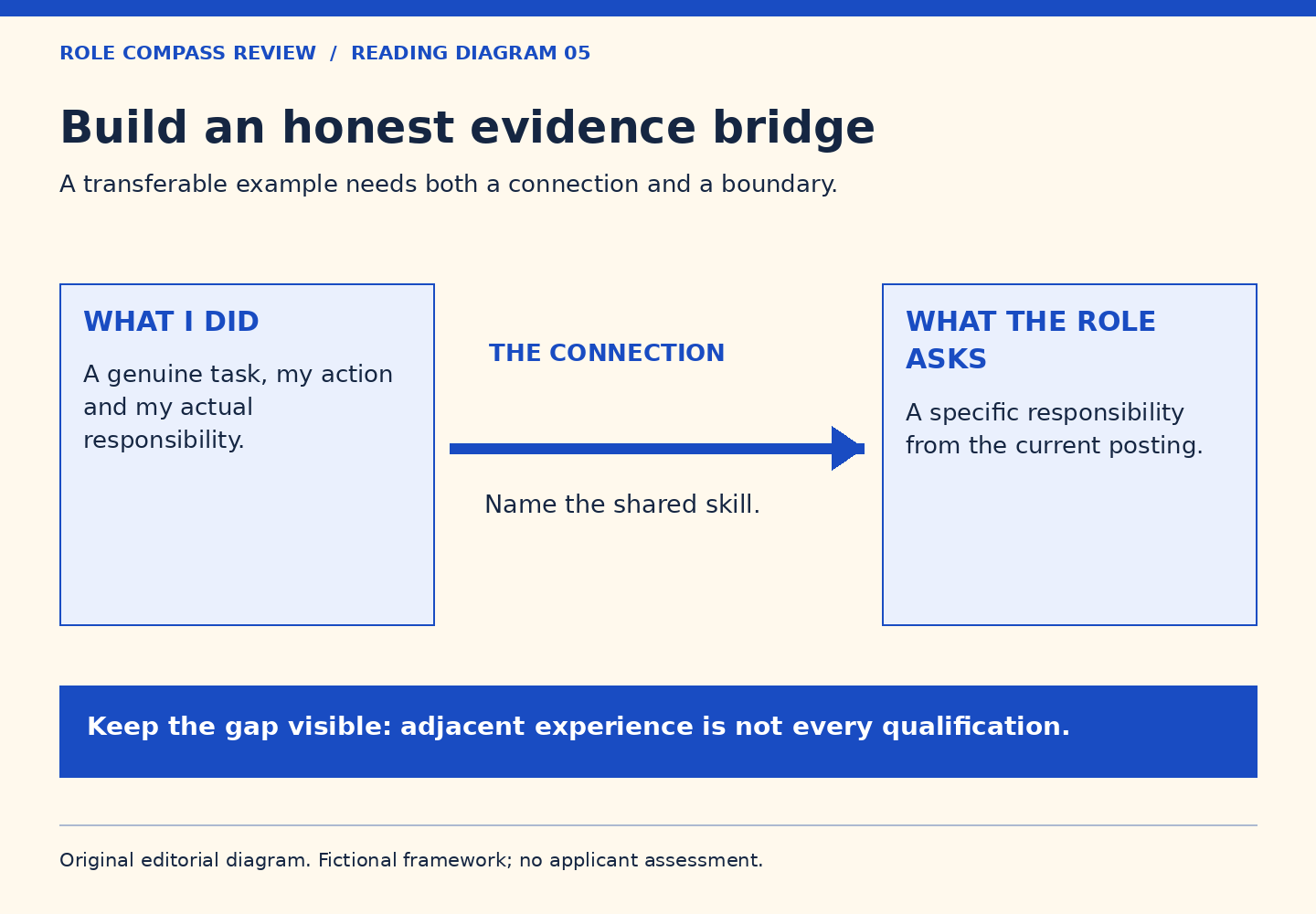
Move from a trait to an example
Words such as reliable, organized and adaptable are easy to write and hard to assess. Start instead with an ordinary task you genuinely performed. What needed doing? What responsibility did you hold? What action did you take? What result could you honestly describe? The answers form an evidence unit that can be compared with a responsibility in the posting.
For a fictional example, a retail worker might describe reconciling an inventory list and flagging discrepancies to a supervisor. That can illustrate attention to records and working within a reporting process. It does not establish experience in a security specialty. The value lies in the precise connection, including the boundary.
Name the shared skill and the gap
Transferability is a relationship between two tasks, not a magic quality attached to a past title. A person who has explained a complicated return policy may have evidence of clear customer-facing explanation. Whether that evidence fits a particular opening depends on the duties and requirements on that page. Avoid claiming that any customer-service background automatically qualifies someone for any security role.
Use two sentences in your own preparation notes: “This example demonstrates…” and “It does not yet demonstrate….” The second sentence is not self-sabotage. It prevents you from building an application around an inference you cannot defend. It can also identify a specific question about the employer’s experience expectations.
Keep scale and ownership truthful
Distinguish helping with a task from owning it, observing a process from performing it, and coordinating peers from supervising employees. Do not convert “assisted a team lead” into “managed the team.” Scale matters too: an occasional duty and a recurring responsibility should not be presented as interchangeable.
You can make an example clearer without inventing numbers. Describe the type of record, the review step or the handoff boundary at a high level. Avoid client names, private workplace documents, sensitive incidents and security arrangements. An application example should demonstrate your contribution without exposing information that does not belong to you.
Match evidence to a small number of duties
Choose two or three central duties from the current posting and pair each with a genuine example or a clearly identified gap. Reusing the same generic paragraph for every opening can conceal the very distinctions you learned from comparing postings. A focused note is easier to verify and easier to adapt honestly.
The public technology postings referenced here ask for specific experience, illustrating why broad confidence and adjacent experience should not be substituted for a stated specialty. This article offers an editorial preparation method, not a resume-screening formula. The employer decides how it evaluates experience, and a strong explanation does not guarantee selection. Keep the public description and your factual evidence together as the basis for the next step.
Source note and limits
Public sources checked October 9, 2026. The discussion above is original editorial analysis. A public posting can change or close; this publication does not verify an opening, evaluate an applicant or make an employment offer.
- External official source: Security Installation Technician III, Phoenix, Arizona; requisition 2026-1655540. Location-specific posting inspected as a comparison, including its separate requisition and required/preferred distinctions. No pay claim is reproduced.