In this article
Separate role families before comparing individual opportunities. Similar industry labels can hide very different kinds of work.
Use a map before a ladder
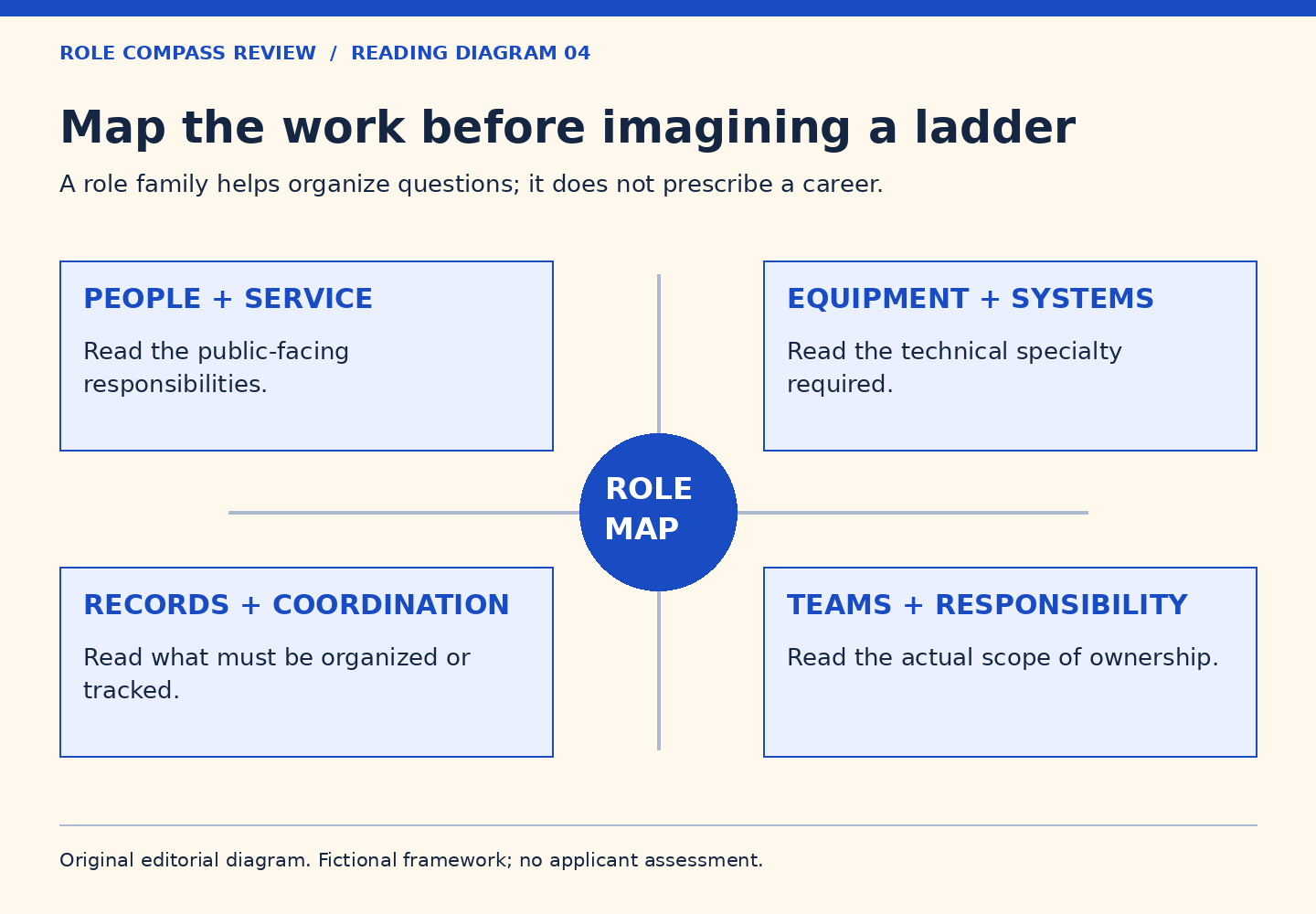
A career ladder suggests one route upward. A role-family map asks a different question: what kind of work is this? A technical installation role, an on-site service role, a coordination position and a management opening can belong to the same broad business while drawing on different evidence. Starting with the map prevents a senior-sounding title from being mistaken for the next natural step for every reader.
The public Allied Universal careers site lists multiple categories, including security officer, event, technology and corporate functions. The technology careers page also separates technician, engineering, coordination and project-management examples. These public categories are useful starting points for research; they are not a complete taxonomy, a personal recommendation or a guarantee that a local vacancy exists.
Look for the work object
Ask what the role primarily works with. Is the description centered on people and service interactions, equipment and installations, records and coordination, or responsibility for a team and a contract? Real jobs can include more than one object. The point is to identify the dominant work rather than forcing every posting into a rigid box.
Then read the evidence the page asks for. Experience resolving ordinary customer questions is not identical to experience installing a technical system. Both may be valuable, but they demonstrate different things. A useful map makes those differences visible without ranking one kind of work as more worthwhile than another.
Compare adjacent paths honestly
Imagine a fictional reader who has coordinated deliveries and kept accurate inventory records. That background could provide examples relevant to coordination. It does not by itself establish technical installation proficiency or supervisory authority. The reader can explore adjacent roles while keeping the limits of the evidence clear.
Another fictional reader may have hands-on technical experience but little interest in managing people. A management title should not automatically become the goal merely because it appears later in a published career diagram. Career exploration can include deeper specialization, a different work environment or a change in responsibility. A public chart cannot decide which outcome matters to you.
Build a short research route
Choose one primary family and one adjacent family, then read a few actual descriptions in a defined location. Write down recurring responsibilities and the distinctions that remain. This gives you a manageable set of comparisons. Collecting dozens of titles before reading any description creates the appearance of research without a clear basis for a decision.
Keep role exploration separate from selection. You can learn about a family before deciding to apply. If a field is unfamiliar, ask what its terms mean in the current description rather than assuming the meaning from another employer. The final product should be a map with useful labels and known gaps, not a promise that every path is accessible or that a particular sequence leads to promotion.
Source note and limits
Public sources checked October 9, 2026. The discussion above is original editorial analysis. A public posting can change or close; this publication does not verify an opening, evaluate an applicant or make an employment offer.
- External official source: Allied Universal careers: public role families. Supports the existence of separate public career categories, a public job search, and the employer recruitment-fraud notice. No vacancy availability guarantee.
- External official source: Technology careers and role families. Supports the presence of technician, coordination, engineering and project-management role families in the technology business. No progression guarantee.