In this article
Compare location-specific opportunities field by field. A shared title or familiar paragraph does not make two requisitions interchangeable.
Anchor each side of the comparison
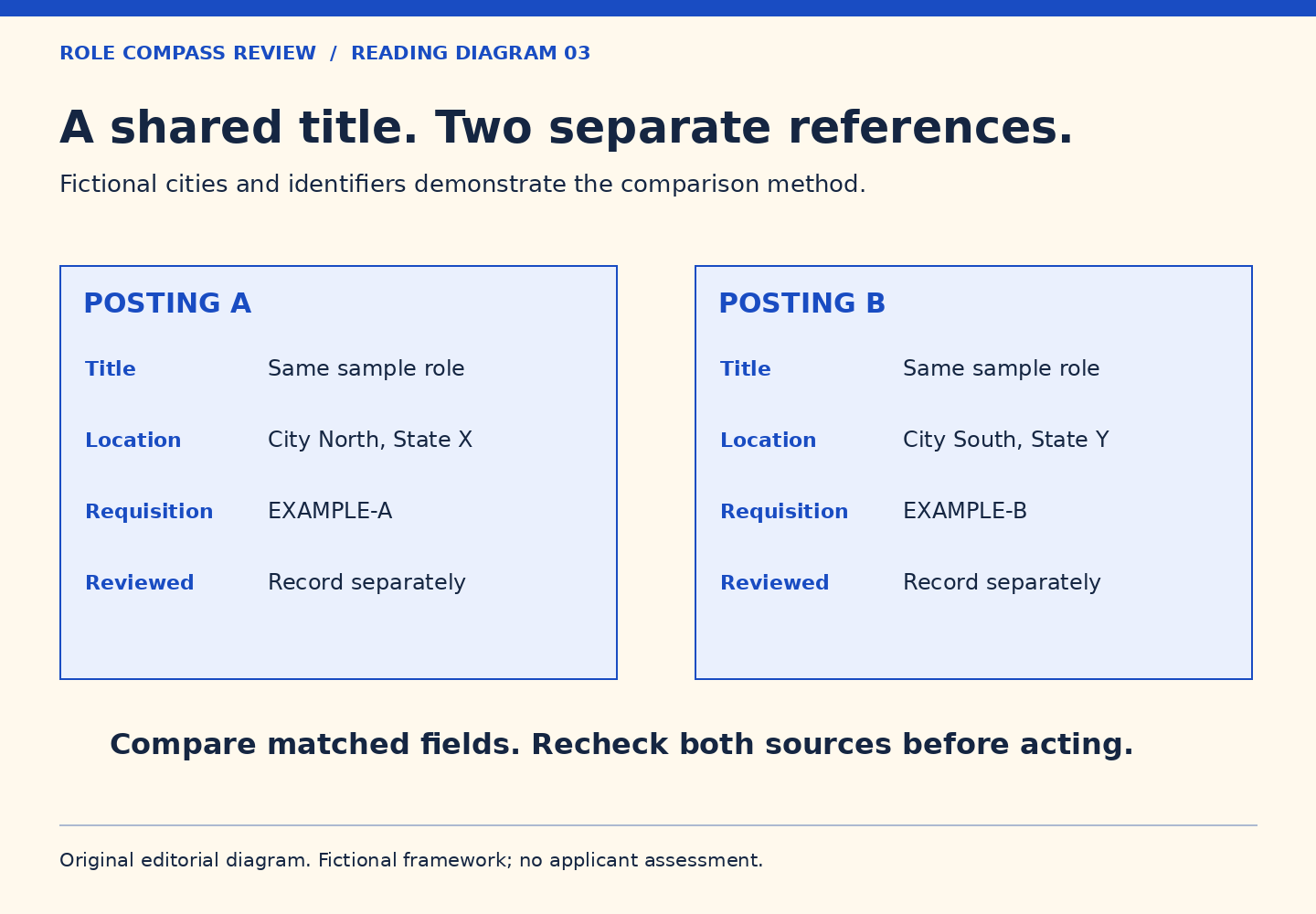
Begin with two separate reference cards. Each needs its own city and state, requisition, official URL and review date. Resist the temptation to keep one generic description and add a second city in parentheses. That shortcut makes it difficult to see which statement came from which page and invites a later update to be applied to the wrong opening.
For this collection, the public careers site displayed Security Installation Technician III in Carrollton, Texas, requisition 2026-1691187, and Phoenix, Arizona, requisition 2026-1655540. The Carrollton page displayed September 28, 2026 as its posting date. These are separate references even where wording overlaps. No claim is made that either remains open when you read this.
Compare matched fields rather than impressions
Put responsibilities beside responsibilities, requirements beside requirements, and unresolved details beside unresolved details. Avoid comparing one page’s marketing introduction with another page’s detailed qualification list. That creates a false contrast between an inviting role and a demanding one when the difference may simply be which paragraph caught your attention.
Use a separate row for each condition. Travel is not the same field as the main location. A broad geographical label is not necessarily the exact reporting address. Employment type is not a complete statement of hours. A common job title is not evidence that the same client, site environment, hiring team or terms apply. These distinctions are questions for comparison, not claims that any particular difference exists.
Repeated text can hide the important delta
When two pages share long paragraphs, read the short unique parts twice. The identifier, city, date, specialized experience and qualifications may carry more decision value than an identical company introduction. A difference need not be dramatic to matter. One conditional sentence can be more useful than several screens of common benefits language.
An original comparison note might say: “The technical summary is similar; these are different requisitions; two conditions still need confirmation.” That is more defensible than “the jobs are the same.” It reports the level of certainty actually earned by the reading. Similar descriptions can justify asking the same questions, but they cannot answer those questions for both opportunities.
Refresh before deciding
A side-by-side comparison has a shelf life. If one page changes, mark which side was rechecked and when. Do not silently update only the details you prefer. Revisit the fields that could change the decision, and record an unavailable page as unavailable rather than filling the gap from an old search snippet.
You do not need to manufacture a winner. Sometimes the useful result is that both deserve further investigation; sometimes one is outside the role family you want to explore; sometimes the evidence is insufficient. A good comparison narrows the next question. It does not promise an offer, a transfer, equivalent compensation or a specific workplace experience.
Source note and limits
Public sources checked October 9, 2026. The discussion above is original editorial analysis. A public posting can change or close; this publication does not verify an opening, evaluate an applicant or make an employment offer.
- External official source: Security Installation Technician III, Carrollton, Texas; requisition 2026-1691187. Location-specific posting inspected: title, requisition, posted date, required versus preferred wording and travel/on-call language. No pay claim is reproduced.
- External official source: Security Installation Technician III, Phoenix, Arizona; requisition 2026-1655540. Location-specific posting inspected as a comparison, including its separate requisition and required/preferred distinctions. No pay claim is reproduced.