In this article
Compare evidence before making a ranking. A useful shortlist keeps material gaps visible instead of hiding them inside a score.
Choose comparison fields before favorites
It is easy to fall in love with a title and then select only the fields that make it look strongest. Set a small comparison frame first: role family, location identity, central duties, qualification wording and important missing information. Use that same frame for every posting in the shortlist. Consistency makes preference more transparent.
This does not mean every field has equal importance. A clearly stated condition may matter more than several preferences. But deciding what matters is different from pretending a point total can assess an applicant. This publication offers a reading method and a fictional demonstration; it does not recommend hiring decisions or score real people.
Use an unknown as information
A missing detail changes what you know, even if it does not change the underlying role. Mark it explicitly. If Posting A states a requirement and Posting B does not discuss it, the correct comparison is not automatically that B has fewer requirements. It is that one page supplies evidence the other does not.
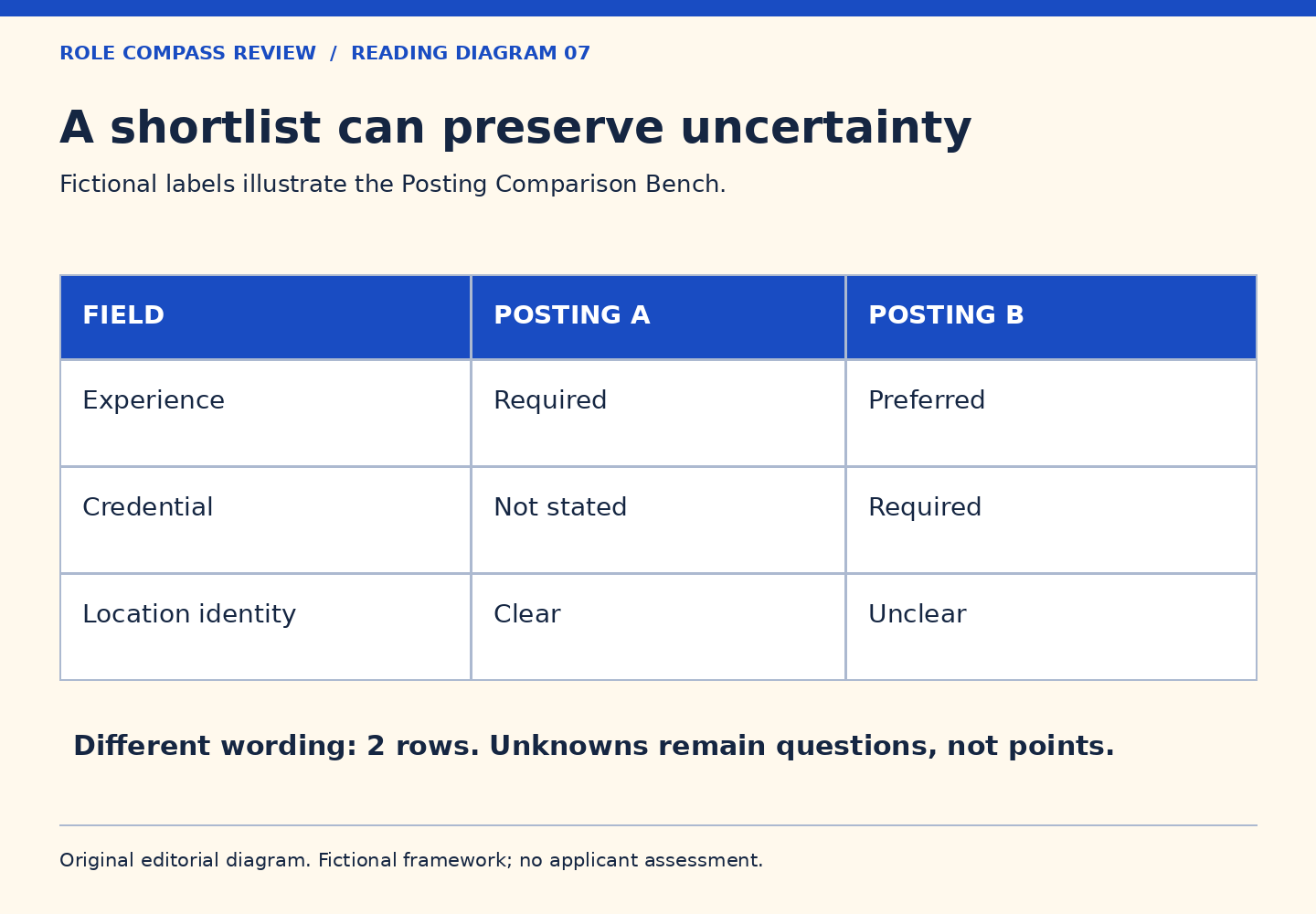
The Posting Comparison Bench on the Home page demonstrates this distinction. It compares two fictional postings across three qualification fields and a location-specific detail check. You choose only preset labels. Its output names wording differences and information gaps; it never says that an applicant qualifies or that one role is better.
Read the bench result critically
If all labels match, the tool reports matched wording, not equivalent jobs. Matching three fields leaves many other aspects unexplored. If the labels differ, the tool reports those differences, not their real-world consequences. If a field is not stated, the tool highlights the need to clarify it instead of rewarding the blank as easier entry.
You can run the same exercise without JavaScript. Draw two columns and three rows for experience, credential wording and driving-condition wording. Add a final row asking whether each fictional posting has enough location-specific information to identify it. Compare each row, then write one unresolved question. No personal data, numerical fit score or career prediction is needed.
Keep the list short enough to refresh
A shortlist has to be maintained if you are going to rely on it. Two well-read current postings are often more useful than a dozen undated snippets. Recheck material facts before taking a consequential step. If a page closes, note the change; do not substitute a different requisition without revisiting the comparison.
End with a decision about research rather than an invented verdict: investigate both, clarify one, or remove a posting that clearly falls outside the work you want to explore. The public careers site is the source for actual openings. This independent site helps explain how to read them and keeps the boundary between public information and an employer’s selection process visible.
Source note and limits
Public sources checked October 9, 2026. The discussion above is original editorial analysis. A public posting can change or close; this publication does not verify an opening, evaluate an applicant or make an employment offer.
- External official source: Allied Universal careers: public role families. Supports the existence of separate public career categories, a public job search, and the employer recruitment-fraud notice. No vacancy availability guarantee.