In this article
A job title is an invitation to investigate. Build a usable picture from the actual location, duties, requirements and unresolved details.
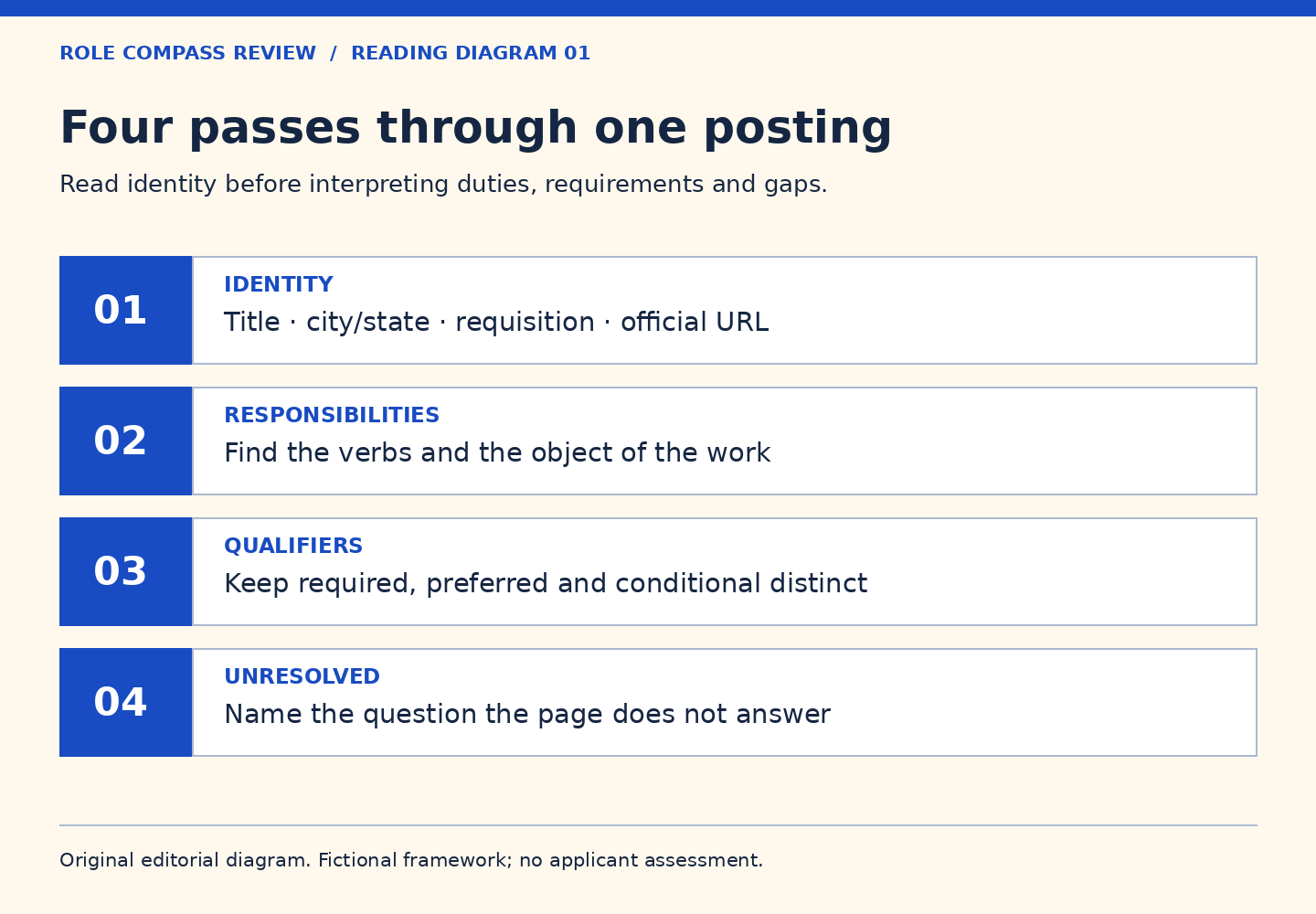
Start with identity, then meaning
Two pages can carry a similar title while describing different opportunities. Before highlighting attractive phrases, write a small reference line in your own notes: employer, title, city and state, requisition identifier, page address, and the date you read it. This makes the object of your research clear. It also prevents a familiar title from quietly standing in for a different opening after a search result changes.
A saved reference is evidence of what you reviewed, not proof that the opportunity remains available. Reopen the official page when you are ready to act. If it has disappeared, do not assume that a copied description on another site is an equivalent live opening. Keep the distinction between a historical note and a current opportunity visible.
Read in four passes
First, identify the role family and location. Second, read the responsibility verbs: support, install, inspect, coordinate, document, supervise. Verbs tell you more about the nature of the work than a promotional introduction does. Third, identify requirements and their conditions. Finally, collect unanswered questions about the terms of the particular opening. This order reduces the chance that an appealing headline determines every later interpretation.
Use different marks for what the page states and what you infer. “The description mentions customer interaction” is a page observation. “I would probably enjoy this” is a personal judgment. Both may matter, but they belong in different columns. A useful comparison preserves the evidence even when your preference changes.
A heading is not the final word
The Piscataway Alarm Panel Monitoring posting reviewed for this article placed several preferred attributes beneath a Minimum Requirements heading. This illustrates why the wording of each bullet deserves attention. A section label can collect statements with different force. Read the sentence, preserve its qualifiers, and avoid turning every bullet into an identical gate.
For a fictional example, imagine a listing that says a certificate is preferred and a particular license is required only for driving duties. Those are not two unconditional requirements. Nor does either sentence prove how a recruiter will evaluate a specific application. Your note should preserve “preferred” and “for driving duties” rather than flattening the description into a yes-or-no checklist.
End with a question list you can use
Limit the first pass to a few material unknowns. Is the location precise enough to identify the opening? Does a requirement apply before applying, before starting, or after hiring? Does the description distinguish duties from qualifications? Asking these questions is more useful than collecting every sentence into a giant note that hides the important gaps.
The outcome of this exercise is a clearer reading, not an application score. A posting is one piece of a hiring process and may omit details that an employer must clarify. Keep the exact public source available for that clarification. If you compare another role later, use the same fields so differences in your note-taking do not masquerade as differences between jobs.
Source note and limits
Public sources checked October 9, 2026. The discussion above is original editorial analysis. A public posting can change or close; this publication does not verify an opening, evaluate an applicant or make an employment offer.
- External official source: Security Officer Alarm Panel Monitoring, Piscataway, New Jersey; requisition 2026-1700709. Supports the narrowly attributed observation that the posting contains preferences under a Minimum Requirements heading, conditional driving language, and a location-specific compensation section. No rate is reproduced.